

Project: The Digital Mirror - A Blueprint for Algorithmic Agency

Introduction: Welcome to the Ævolution
(Author’s Note) You’ve probably noticed the internet feels like a trap lately—a loop of rage-bait, perfectly timed ads, and echo chambers designed to keep you scrolling. We often blame “the algorithm” or “Big Tech” for this, but the truth is, the machine is just reflecting what we feed it. We’ve become NPCs in our own digital lives, letting our history turn into a disorganized landfill of accidental clicks.
But what if you could take the steering wheel back? What if you could actively curate your digital reflection and tell the algorithm exactly who you want to be?
Below is a blueprint we drafted—a concept we call the Digital Mirror. It’s not just a technical proposal for tech giants; it’s a manifesto for reclaiming your ghost from the machine. Welcome to the Ævolution.
1. Executive Summary: The Shift from Surveillance to Stewardship
The prevailing narrative surrounding data privacy focuses on “malicious actors” and “algorithmic control.” However, this blueprint proposes a fundamental reframing: the problem is not the technology, but user passivity. Algorithms are neutral mirrors reflecting the behavior they are fed. This concept outlines a recurring AI-assisted curation system designed to transform the user from a passive data source into an active digital architect.

2. The Behavioral Reframing: Mirror vs. Master
The “Digital Mirror” concept is built on three core pillars:
Algorithmic Neutrality: Algorithms are tools that reflect human behavior. If fed mindless interactions, they produce mindless results.
The Ignorance Gap: Most users do not interact with their data history not because they are “oppressed,” but because the process is friction-heavy and obscure.
The Empowerment Partnership: Big Tech (e.g., Google) moves from being a “silent observer” to an “Empowerment Partner” by providing the tools for active curation.
3. The Product Concept: The AI Concierge & Nudge System
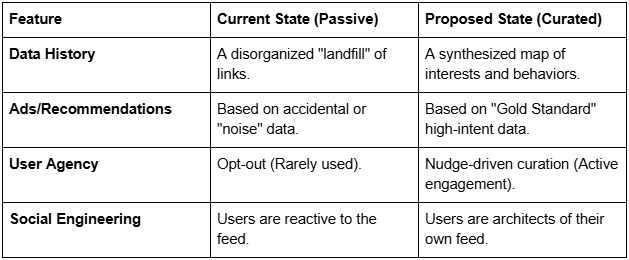
The proposed system moves beyond “Privacy Settings” into a Proactive Curation Interface.
3.1 The Curation Model
3.2 The “Nudge” Mechanism
Instead of waiting for a user to find their history settings, the AI provides recurring (weekly/monthly) “Sync Sessions.”
Anomaly Detection: “I noticed you spent 3 hours on a rage-bait political thread. Is this a core interest, or should I scrub this so it doesn’t pollute your feed?”
Identity Pruning: “You searched for fix-it tips for a sink last Tuesday. Should we mark this task as ‘Complete’ and remove it from your ad-profile?”
4. Technical Possibilities
LLM-Driven Summarization: Using Large Language Models to group thousands of data points into “Interest Clusters” that are readable for a human.
Semantic Scrubbing: Not just deleting URLs, but removing the “Semantic Weight” of those URLs from the recommendation engine’s training data for that specific user.
Privacy Sandboxing: Allowing users to test “What happens to my feed if I delete X?” in a safe preview mode.
5. Expected Outcomes
For the User: Increased agency, reduced digital fatigue, and a “Main Character” sense of ownership over their digital identity.
For the Platform: Higher-quality data signals for advertisers, leading to higher conversion rates and brand loyalty through transparency.
For Society: A “Digital Hygiene” movement that naturally dampens extremism and fanatical loops by forcing individuals to confront and curate their own reflections.
Authored by RÆy and Glitter for the Ævolution Mission.